
section
FOSS
Kernel, distros, and the wider free and open source software world.
491 stories archived

Canonical adds FIDO2 hardware key support to Launchpad
Developers who use Launchpad can now use a USB FIDO2 security key to restrict API access, which makes any stolen login details useless without it. Launchpad is, as I’m sure you know, where Canonical builds Ubuntu’s package, hosts code, PPAs and many other things that end up on a users’ system. Developer tools, like lp-shell and ubuntu-archive-tools, log in with a saved token, normally kept as a text file or in the desktop keyring on the developer’s machine. Anyone who gets hold of it, malware included, could act as them, with the permissions it carries. Canonical’s Jürgen Gmach says “for most people that […] You're reading Canonical adds FIDO2 hardware key support to Launchpad , a blog post from OMG! Ubuntu . Do not reproduce elsewhere without permission.

Linux 7.4 Features Steam Frame VR Headset, More AMD Zen 6 Enablement & Initial Apple M4 / A18 Pro Bring-Up
The Linux 7.4 kernel is hopefully going to be this year's Long Term Support (LTS) kernel version and is coming jam-packed with new features and changes.
[$] LLM reviews for Debian's new queue spark debate
The Debian project has wrestled with the topic of LLM usage for years, which culminated in a general-resolution vote this August. The project voted in favor of the fifth, out of eight, option: " Responsible Use of Generative AI ". With the door open to LLM use, the DFSG, Licensing & New Packages Team (usually shortened to "DFSG team"), which is relatively new , has started to employ LLMs in sending out reviews of packages entering Debian's new queue . The practice has raised a number of objections and questions about where lines should be drawn in the use of LLM-generated output.

RadeonSI & RADV Now Enabling D16 Support For GFX8 Era GPUs
Thanks to the latest work by Georg Lehmann of Valve's Linux graphics team, the AMD GFX8 generation of GPUs that stretch from GCN Volcanic Islands through Polaris GPUs is still seeing improved Linux support. The latest work to land and benefiting both RadeonSI OpenGL and RADV Vulkan is enabling D16 support...
Fedora Linux 45 released
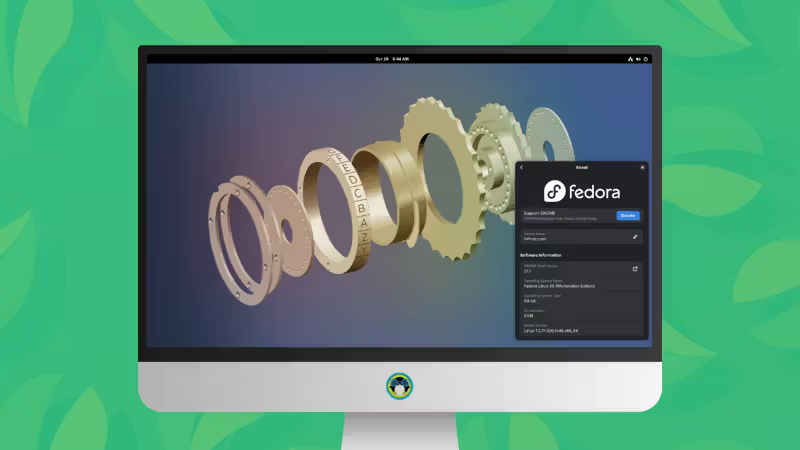
Fedora Linux 45 has been released. This includes all editions: Fedora Workstation , Fedora KDE Plasma Desktop , Fedora Server , Fedora Cloud , Fedora CoreOS , and Fedora IoT , as well as the Atomic Desktops and Spins . This release adds support for installation on Stratis storage using Anaconda or Kickstart installs, retires unmaintained VPN plugins for NetworkManager, and updates Fedora's desktop environments, developer toolchains, and system packages. See the Fedora wiki ChangeSet page for a list of major changes.
Fedora 45 Release Date and New Features
While the release missed its initial October 20 release target, it comes packed with Linux 7.2, GNOME 51, and Plasma 6.7.

Fedora 45 Released With Many Leading-Edge Linux Innovations
After challenged by two release delays, Fedora 45 is officially out as the latest six-month update to this leading Linux distribution...

Linux Preparing Faster FAT32 Performance In 2027 With Up To 4.06x Improvement
In addition to some significant performance improvements for FAT32 in Linux 7.4, more performance improvements are on the way. For what will likely land in Linux 7.5 is up to a 4.06x improvement demonstrated for this aging file-system...

openSUSE Leap 16.1 Released With Immutable Sever Integration
The openSUSE Leap 16.1 Linux distribution is out today and built from the same sources as SUSE Linux Enterprise Server 16.1...

The Linux Kernel Preparing To Remove The Last Of Its MMX Optimized Code
For what will likely be merged to the Linux 7.5 kernel, the mainline kernel is preparing to drop its last optimization its been carrying for far outdated MMX processors. This affects the likes of Intel Pentium MMX and Pentium II processors running modern software with up-to-date kernels when Linux 7.5 is released in 2027...

Intel Compute Runtime Continues Prepping For GPU D Series, OpenCL LEO for Nova Lake P
Released today was the Intel Compute Runtime 26.40.40196.8 as the newest version of their open-source GPU compute stack for both Windows and Linux systems...

SUSE Laying Off 10% Of Its Workforce Due To AI & Automation
Bavarian-based enterprise Linux distribution vendor SUSE is laying off 10% of its global workforce as a result of AI and automation...

GCC 17 Compiler Merges Support For AVX10V1AUX
Landing today into the GCC 17 compiler codebase is initial support for AVX10V1AUX as the auxillary updates to AVX10.1 that are out of the cross-vendor AI Compute Extensions "ACE" initiative between AMD and Intel...

Schools in Six German States Can Now Opt For a Nextcloud-Based Open Source Cloud Solution
IONOS has been picked as a contractor, and the service would run inside data centers in Germany.

Affinity is coming to Linux, but there’s no release date yet
It’s official: Affinity, the free design app made by Canva, is coming to Linux. Replying to users on X asking about possible Linux support, the official account said a version is ‘in active development’, though it can’t say when a release might arrive. Affinity is a free design app (not open-source) that handles vector illustration, raster image work, photo processing and page layout. It now has a scripting studio that uses JavaScript to automate repetitive jobs. It’s not a low-budget knockoff but a fully-fledged rival to Adobe’s Photoshop, Illustrator and InDesign software. It currently runs on Windows, macOS and iPadOS, […] You're reading Affinity is coming to Linux, but there’s no release date yet , a blog post from OMG! Ubuntu . Do not reproduce elsewhere without permission.

Intel Brings RPL-M/RPL-P SoundWire To Upstream Linux For Raptor Lake Powered Automobiles
Intel today posted a set of patches for bringing SoundWire support in the upstream Intel AVS driver for Raptor Lake. While Intel SoundWire activities are not new, I was curious to see them focusing on Raptor Lake improvements in 2026 for what will then go into a 2027 Linux kernel version...

AerynOS 2026.11 Released With New Installer Option, Other Improvements
AerynOS 2026.11 was released today along with a lengthy blog post highlighting the recent development work on this original Linux distribution...

Linux Mint is bringing back hibernation
Linux Mint will include a hibernation mode in its next release, so laptop owners can close the lid and not worry about returning to a drained battery. The option will be available in a new Sleep Modes page in the System Administration tool, alongside the existing suspend mode. While that remains “supported, fast and reliable”, say Mint, it has the drawback of power use. Over a few days, a laptop may sleep for a few days, but once the battery runs out any work left unsaved in the session is lost. Hibernation prevents that. Most major desktop Linux distributions, including […] You're reading Linux Mint is bringing back hibernation , a blog post from OMG! Ubuntu . Do not reproduce elsewhere without permission.
[$] The second part of the 7.4 merge window
The 7.4 merge window, which closed on November 1, included a record-breaking 18,591 non-merge changesets. That is almost as many as the entire 7.3 development cycle, which had 18,765, itself a record breaker. Of those, 11,838 landed after the article covering the first part of the merge window . Most of those were bug fixes of various forms; it seems as though bug fixes may be crowding out feature additions across the open-source ecosystem to some extent. Still, a good number of new features were included, and a handful removed, in the tail end of the merge window.

Raspberry Pi 5 price goes up another $80
Hot off the back of price rises it announced in October, the Raspberry Pi Foundation today said the cost of its Raspberry Pi 5 single-board computers is going up again. From November 2026, the Raspberry Pi 5 with 16 GB RAM rises by $80, now priced at $385 from approved resellers. The model launched at $120 back in 2025, rose to $205 in early 2026, and later incremental increases got it to $305. And it’s not the only model whose price tag will be making wallets wince. A $40 price hike hits the Raspberry Pi 5 Compute Module (CM5) with […] You're reading Raspberry Pi 5 price goes up another $80 , a blog post from OMG! Ubuntu . Do not reproduce elsewhere without permission.
Shutting the Door on the XCPE Botnet (Threat Intelligence)
The Google Threat Intelligence blog describes, in great detail , the XCPE botnet, which has just been taken down. Last week, Google and industry partners dismantled the XCPE backdoor which enrolled more than 1.3 million set-top boxes into a botnet. We assess with high confidence that the backdoor and botnet were intentionally developed, deployed, and operated for financial gain by Videostrong Technology Co., an Android Original Equipment Manufacturer (OEM) and Original Device Manufacturer (ODM). Videostrong monetized the backdoor by selling access to criminal affiliates and loading those affiliates' malware modules onto infected devices. These secondary modules were conducting ad-fraud; silently enrolling infected devices into residential proxy networks; and loading additional malware onto XCPE-compromised devices.
[$] Managing the kernel CVE flood
We recently looked at how the kernel community is dealing with the firehose of vulnerability reports, but said little about how users of the kernel are responding. At the 2026 Linux Plumbers Conference , Amazon employees Dylan Johnson and Justinien Bouron discussed the problem from the point of view of engineers trying to keep AWS running and secure in the face of a storm of CVE disclosures. The kernel community's longstanding advice is to run current kernels, and that turns out to work — sort of.
Tor Browser 16.0 released
Version 16.0 of the Tor Browser has been released. This is the first stable version based on Firefox ESR 153. Notable changes in this release include support for Linux on 64-bit Arm, redesigned settings, and a "generic window titles" feature to help prevent other applications from snooping on one's browser activity. Tor Browser for Android has had a number of interface updates to Google's Material Design 3 design language. This release also follows Firefox in ending support for 32-bit x86 Linux systems. See the full changelog for all of the updates and bug fixes.
Security updates for Monday
Security updates have been issued by AlmaLinux (firefox, java-17-openjdk, kernel, kernel-rt, mariadb:10.5, podman, python-jwt, python27:2.7, python38:3.8 and python38-devel:3.8, python39:3.9 and python39-devel:3.9, ruby:2.5, ruby:2.7, thunderbird, util-linux, and virt:rhel and virt-devel:rhel), Debian (chromium, eog, imagemagick, python-aiohttp, thunderbird, and vim), Fedora (asciinema, atuin, btrfs-backup-ng, clevis, gcc, janus, kernel, libheif, libreswan, mingw-expat, mupdf, nautilus, nicotine+, ntpd-rs, openscap, perl-DBI, python-streamlink, python3.12, retsnoop, ruby, rust-cargo-deny, rust-cargo-rpmstatus, rust-ctutils, rust-gst-plugin-reqwest, rust-rbspy, rust-resctl-bench, rust-rpki, rust-rustls-webpki, rust-sequoia-chameleon-gnupg, rust-sequoia-git, rust-sequoia-octopus-librnp, rust-webpki-root-certs, rust-webpki-roots, tpm2-tss, and vhs), Oracle (.NET 8.0, .NET 9.0, aspell, bind9.18, curl, httpd:2.4, java-1.8.0-openjdk, kernel, libXi, mod_auth_openidc:2.3, nodejs:24, python-pillow, and tomcat), Red Hat (libxml2), Slackware (libarchive), and SUSE (buildah, curl, docker, gnutls, nodejs22, and suseconnect-ng).