
section
FOSS
Kernel, distros, and the wider free and open source software world.
668 stories archived

FreeBSD Desktop Installer Option Working Through NVIDIA Driver Handling, Licensing
Alfonso Siciliano, who has been one of the FreeBSD developers leading the effort on adding a KDE-based desktop option to the FreeBSD installer, provided an update on recent work around adding integrating this desktop option...

GNOME OS Creating "Test Center" As Its Take On Apple TestFlight For Experiment Software
GNOME developers working on GNOME OS have received funding from Germany's Prototype Fund to work on creating the GNOME OS "Developer Tool Suite" or also tentatively called their "Test Center" to help in testing experimental applications/libraries in a modern Linux computing world with systemd-sysext, Buildstream, and other newer tech...

Reworked System Call Entry Handling Slated For Linux 7.3
Stemming from looking at a proposed Linux kernel patch to alter the Linux kernel's system call number handling, veteran Linux kernel developer Thomas Gleixner went down a rabbit hole of the kernel's system call entry handling to make a number of clean-ups and improvements to the code. That rework to the system call entry handling is now expected to land for the Linux 7.3 kernel cycle...

Raspberry Pi 5 IOMMU Driver Being Worked On For The Mainline Linux Kernel
While the Raspberry Pi 5 is already over two and a half years old, one of the missing elements of its support from the mainline Linux kernel has been the IOMMU driver. We are now seeing Raspberry Pi's downstream IOMMU driver being adapted for mainline with hopes of getting it into the upstream kernel...

Cloud Hypervisor 53 Released With Offloaded Snapshot/Restore Daemon
Cloud Hypervisor 53.0 is now available for this open-source, Rust-based VMM focused on cloud workloads and modern security needs. Originally started at Microsoft, Cloud Hypervisor continues seeing new development these days by Microsoft, Meta, Arm, and other organizations...

Open Book Touch is Crowdfunding: A Buttonless, Open Hardware Answer to Kindle
It's $149, runs on an ESP32-S3, and skips DRM entirely and lets you skip the Kindle ecosystem.
Kernel prepatch 7.2-rc3
The 7.2-rc3 kernel prepatch is out for testing. Linus said: " Things continue to look normal (the 'new normal' with slightly higher rates of commits, although I do get the feeling that we're seeing that slightly balanced out by people starting to go on summer vacation) ".

How to change Night Light’s colour temperature during the day on Ubuntu
Night Light Scheduler is a new GNOME Shell extension that lets you control how warm your screen is throughout different parts of the evening (or day). GNOME’s built-in Night Light feature has a customisable schedule, and it lets you set a colour temperature that’s very orange, or less orange to filter out blue light. But that temperature holds the entire time Night Light is switched on. It eases in and out at each end but never changes in between. For most use cases, the default behaviour is fine; set and forget to a schedule. But if you wish you could […] You're reading How to change Night Light’s colour temperature during the day on Ubuntu , a blog post from OMG! Ubuntu . Do not reproduce elsewhere without permission.

Linux 7.2-rc3 Released: Close To The "New Normal"
Linux 7.2-rc3 is now available for testing in working toward the stable Linux 7.2 kernel version coming up in August...

Linux 7.2 Enabling UltraRISC RISC-V Support In The Default Kernel Build
Similar to Linux 7.2 enabling Eswin SoC support by default in the RISC-V "defconfig" kernel build, UltraRISC RISC-V coverage is also now being enabled by default for RISC-V kernel builds in Linux 7.2...

HFI BIOS Aims To Provide A POST-Like Power On Screen & BIOS Setup Utility For RISC-V
The Harmonic Firmware Initiative "HFI" is trying to provide a generic, standardized power-on firmware experience for RISC-V boards. Akin to the x86 world with having immediate graphics card initialization to provide a display while the system is booting and also having a BIOS setup utility for system configuration, HFI is trying to do the same for the RISC-V world...

Linux 7.2-rc3 Bringing Fixes For The SEGA Dreamcast Drivers In 2026
It wasn't on my bingo card for the week but merged to Git ahead of today's Linux 7.2-rc3 kernel release are a number of fixes for the SEGA Dreamcast drivers...

Realtek RTL8723BS WiFi Linux Driver Hardened Against Malicious WiFi Access Points
The staging driver fixes that were sent out this week ahead of the Linux 7.2-rc3 release is predominantly made up of hardening the Realtek RTL8723BS WiFi driver. In particular, a number of fixes for addressing out-of-bounds behavior when connecting to "bad" WiFi hosts...

Debian 13.6 Released To Ship All The Latest Security Fixes, Reverts GeoIP Database
Debian 13.6 is out today as the newest point release of Debian Trixie to ship the latest security fixes and other maintenance updates...

Linux 7.3-rc3 Bringing Display Detection Improvement To Help Some Multi-GPU Systems
Sent out today was this week's round of x86 (x86_64) fixes ahead of the Linux 7.3-rc3 kernel test candidate due out on Sunday...

LLVM Merges x86 LFI "Lightweight Fault Isolation" Target For In-Process Sandboxing
Stanford researchers have been developing Lightweight Fault Isolation "LFI" compiler passes and targets for LLVM as a means of efficient, native code sandboxing. The AArch64 LFI target was previously upstreamed while this week the x86/x86_64 LFI target was also upstreamed for this means of in-process sandboxing...

KDE Developers Continue Landing More Features For Plasma 6.8
KDE developers continue to be very busy this summer landing more features for the upcoming Plasma 6.8 desktop...

Mesa's Rusticl Now Enables Arm Mali Panfrost Driver Support By Default
A change upstreamed to Mesa by an Arm engineer now enables the Panfrost Gallium3D driver for Arm Mali graphics to work with the Rusticl driver by default...
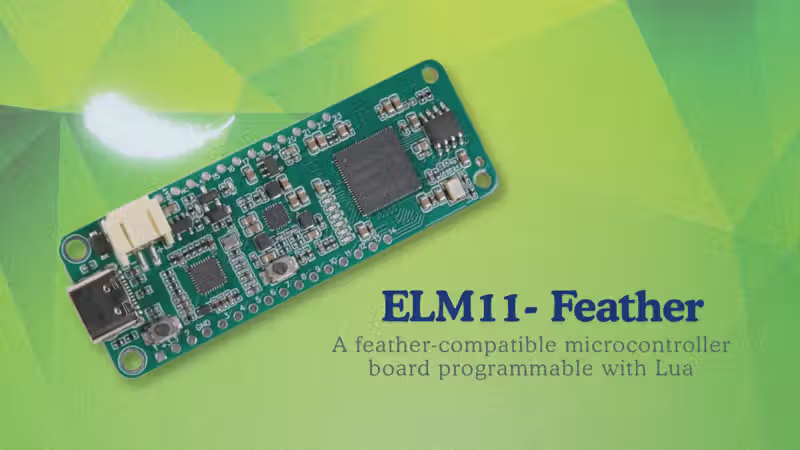
ELM11-Feather Is a Feather-Compatible Board That Speaks Lua Natively
It's an FPGA-based board that lets you program the application, driver, and hardware layers in Lua, C, and VHDL/SystemVerilog, and it starts at $29.

Ubuntu 26.10 retires dbus-daemon after 22 year run as default
Ubuntu 26.10 is replacing its D-Bus implementation for the first time since 2004, swapping dbus-daemon for dbus-broker – a change end-users are unlikely to notice. Processes on your desktop talk to each other and to the host system using D-Bus, a ‘message’ bus. This is what the Ubuntu Dock uses to show unread-count badges for apps, what tells your desktop a USB drive has been plugged in, and so on. Two buses are in play. There’s aa system bus, shared across the whole device, handling hardware and background services, and a user session bus to handle desktop and app integrations […] You're reading Ubuntu 26.10 retires dbus-daemon after 22 year run as default , a blog post from OMG! Ubuntu . Do not reproduce elsewhere without permission.

Pop!_OS Rolls Out Its "Frosted Glass" Desktop Style For COSMIC
System76 developers have for the past number of weeks been working on developing a "frosted glass" appearance for the COSMIC desktop environment featured on their Pop!_OS Linux distribution. For Pop!_OS users this frosted glass feature is now available and will become more widespread for other Linux distributions once the next COSMIC release is formally tagged...

Wine 11.13 Better Supports Input Pointers, Improved Keyboard Scancode Mapping For X11
Wine 11.13 is out today as the newest bi-weekly development release for this open-source software enabling support for running Windows games and applications on Linux...

KDE Plasma 6.7 X11 vs. Wayland Session Gaming Performance For NVIDIA On CachyOS
With KDE Plasma 6.7 now having seen a few point releases to further polish this last version with X11 support ahead of Plasma 6.8 going Wayland-only, here are some NVIDIA Linux gaming benchmarks between the X11 and Wayland sessions on Plasma 6.7.2 using the popular Arch Linux based CachyOS.
[$] An update on the scraper situation
Our article " Fighting the AI scraper bot scourge ", published in early 2025, discussed the problem of widespread scraping of web sites in search of training data for large language models and related projects. This activity overwhelms sites with traffic. Over a year after that article is published, the problem is still growing. The hammering of sites by shadowy actors has reached new heights, and the open web is becoming increasingly difficult to maintain. Where is this traffic coming from, and what can be done about it?